
St. Mary's County Arrest Warrants Explained
An arrest warrant is a written order telling a peace officer to take a named person into custody. That is all it does. It opens a case. The charge itself still has to be proven, dismissed, or resolved in court. Maryland also lets a case move by summons, which orders an appearance without commanding an arrest on the spot. The charging officer weighs the circumstances and picks one or the other, and that choice is recorded with the process. So in St. Mary's County, two people facing the same charge could get entirely different paperwork. A docket entry alone will not confirm whether a warrant is active. For that, you need the issuing court.
From Statement of Charges to Commissioner Review
Everything begins with an application for a statement of charges. In St. Mary's County, that application may grow out of a police report or a private complaint. A District Court commissioner then reviews the alleged facts, decides whether probable cause exists, and chooses the process that fits.
- A report or application identifies the alleged facts and the person involved.
- The statement of charges and supporting facts go to a commissioner or another authorized judicial officer.
- The officer reviews probable cause and the legal criteria for a summons against an arrest warrant.
- The process records the court, case, charge, and the agency directed to serve it.
- The agency serves the process, and the return goes back to the issuing court.
Access stays limited before service. That is why an unserved or sealed St. Mary's County warrant may not appear on any public page you check.
Inside a St. Mary's County Arrest Warrant
Maryland warrant forms carry a standard set of entries. A public St. Mary's County docket shows only part of them. The rest you may need to ask the clerk about directly.
| Caption | The form label, such as arrest warrant, State capias, or a contempt caption. |
|---|---|
| Case number | The docket identifier, for example C-07-CR-26-000482. |
| Person named | The legal name and known identifying details, where the record is public. |
| Charge or order | The offense alleged or the order that was violated. |
| Issuing judge | The judicial officer who signed, and the issue date. |
| Directed agency | Which law-enforcement office is asked to serve the process. |
| Appearance or bond | Any instruction about appearing or posting bond after arrest. |
| Return | What the serving agency filed back with the court. |
Arrest Warrant Versus Search Warrant
A St. Mary's County judge can sign either document, and both need probable cause. But they do different things. An arrest warrant puts a person in custody. A search warrant lets officers enter a described place and seize described items.
| Point | Arrest Warrant | Search Warrant |
|---|---|---|
| What it authorizes | Custody of a named person | A search of a place and seizure of items |
| Who reviews it | A commissioner or a judge | A judge, on a sworn affidavit |
| County practice | Risk review, then service by the Sheriff | Supervisor and command review, threat assessment, then execution |
| What follows | Booking, appearance, or bond | A receipt and a return filed with the judge |
Sheriff Policy 607 spells out the St. Mary's County search-warrant checklist: nexus to the place, a specific description, known residents, item descriptions, and any known exculpatory information.
Serving Arrest Warrants in St. Mary's County
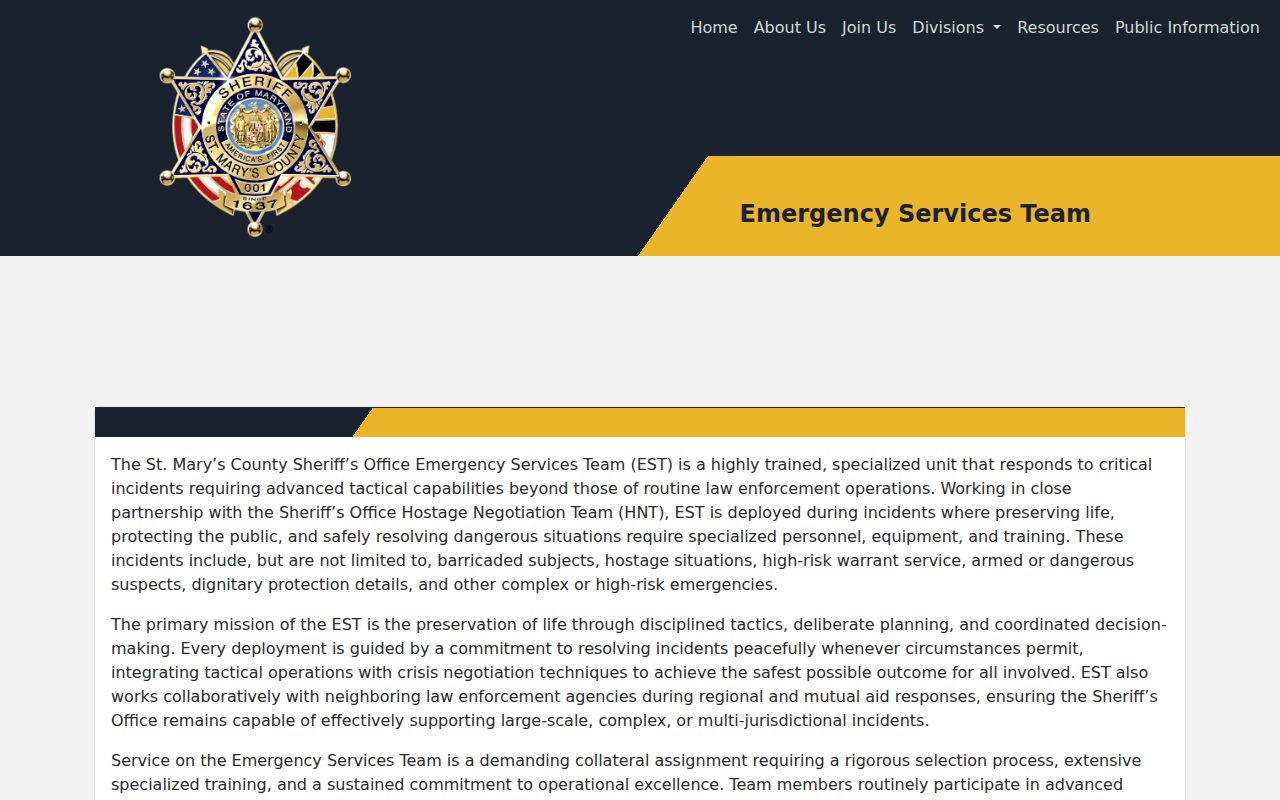
The St. Mary's County Sheriff's Office serves county warrants, but service is not one uniform procedure. High-risk entries are coordinated through the Emergency Services Team, which also supports search and seizure warrants and lists felony warrant service among its capabilities. The Emergency Services Team page lays out that capability in plain terms, with no case details attached. For ordinary service, deputies weigh a residential entry against an arrest made outside. When another agency asks to serve a county warrant, the request goes to the Criminal Investigations Division commander, the warrant location gets verified, and mutual aid can cover work that crosses jurisdictions.
St. Mary's County Sheriff's Office
23150 Leonard Hall Drive
Leonardtown, MD 20650
301-475-4040
Pre-Execution Affidavits and What Stays Sealed
An affidavit is the sworn statement behind the process. It is often the most protected document in a St. Mary's County file. Maryland restricts certain warrant applications and supporting affidavits before execution and filing, and investigative material can stay closed even after that.
Key Rules:
Judicial record access - Warrant applications and affidavits can be withheld before execution, along with grand jury and investigative material.
Criminal Procedure §1-203 - Search warrants issue on probable cause, and the affidavit can be sealed.
Courts & Judicial Proceedings §3-8A-27 - Juvenile records stay confidential.
When St. Mary's County withholds a document, ask which category applies. Then ask whether a redacted or non-identifying portion can be released.
Comparing Arrest, Summons, and Bench Warrants
Three papers, three jobs. Callers to a St. Mary's County courtroom blur them constantly. The label on your paperwork tells you which one you hold.
| Process | How It Starts | What It Requires |
|---|---|---|
| Arrest warrant | A charging application with a probable-cause finding | Custody of a named person |
| Summons | The same charging review, with a lesser custody concern | An appearance, with arrest as a later consequence |
| Bench warrant | A missed date or a failed release condition | Arrest in a case the court already has |
A summons is not an arrest warrant. But ignoring one can produce a St. Mary's County bench warrant later. Serving any of the three does not end the case itself.
Outside-Agency Service and Mutual Aid
Not every St. Mary's County warrant gets served by a county deputy. Policy 607 sends outside-agency service requests to the Criminal Investigations Division commander, requires the warrant location to be verified first, and permits mutual aid, meaning another agency can serve a county warrant in its own area. That matters when someone has moved, works out of state, or has a case in two jurisdictions. The issuing court still controls its own process, so end any call about service with the court's name and the case number written down. Note: a case appearing in a public summary does not establish that a warrant was served, or that one remains open.
If There's an Arrest Warrant for You
Here the order of your steps matters most. Talk to a Maryland criminal-defense attorney before you walk in voluntarily. The St. Mary's County cases that go well are usually the ones where the surrender, the bond, and the first appearance were planned together in advance.
Important: Do not arrange a surrender with a caller who demands payment, and do not assume a counter visit clears an arrest warrant.
Steps that apply across warrant types, including attorney contact, bond, and recall, sit on the county warrant records home page. St. Mary's County publishes no bond-window hours or accepted payment methods. Confirm both with the court.
Federal Arrest Warrants Are a Separate Route
A federal case never runs through the county process. The U.S. District Court for the District of Maryland covers St. Mary's County through its Southern Division, which sits in Greenbelt alongside Calvert, Charles, Montgomery, and Prince George's counties. Federal dockets are read through PACER or at the federal clerk's office, and the U.S. Marshals Service handles federal fugitive work for the district. Take a federal question to a commissioner station and you waste the trip.
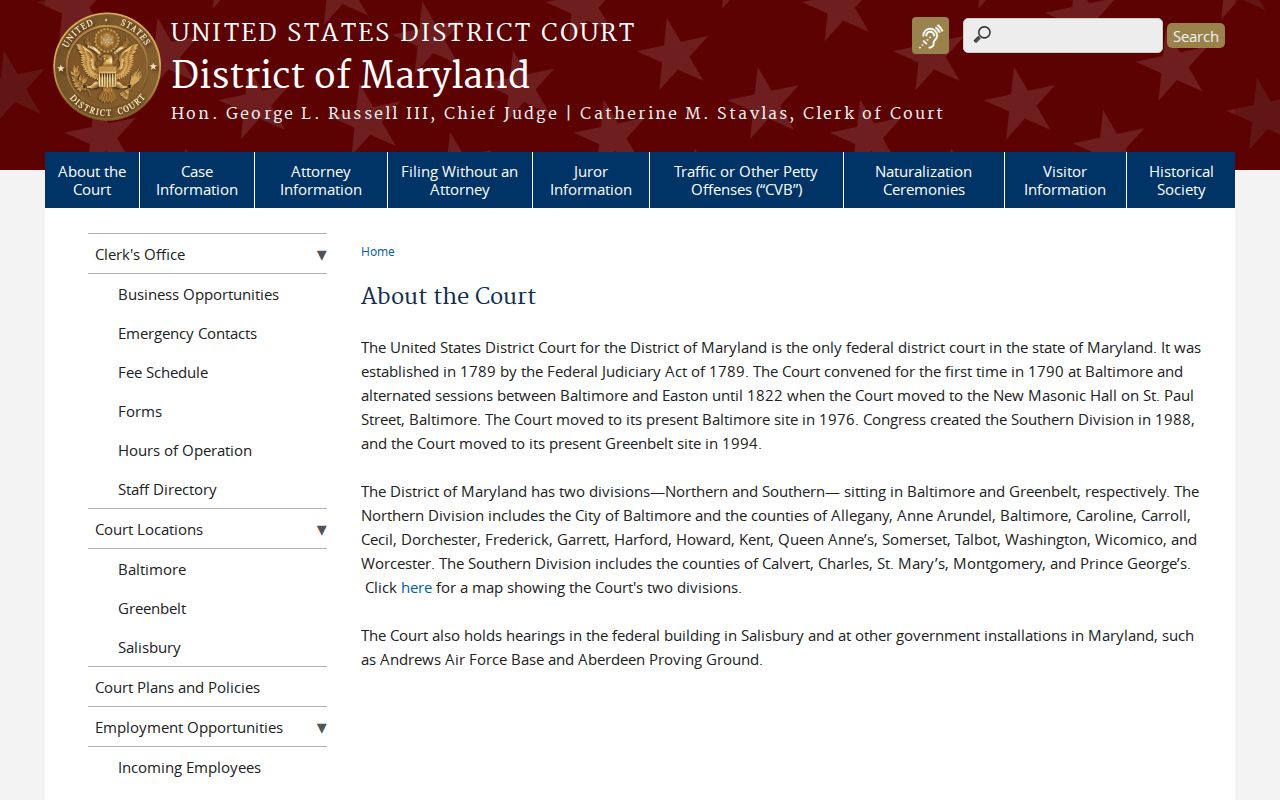
The District of Maryland page lists the Southern Division. Confirm the docket number before calling anyone about a St. Mary's County federal matter.